
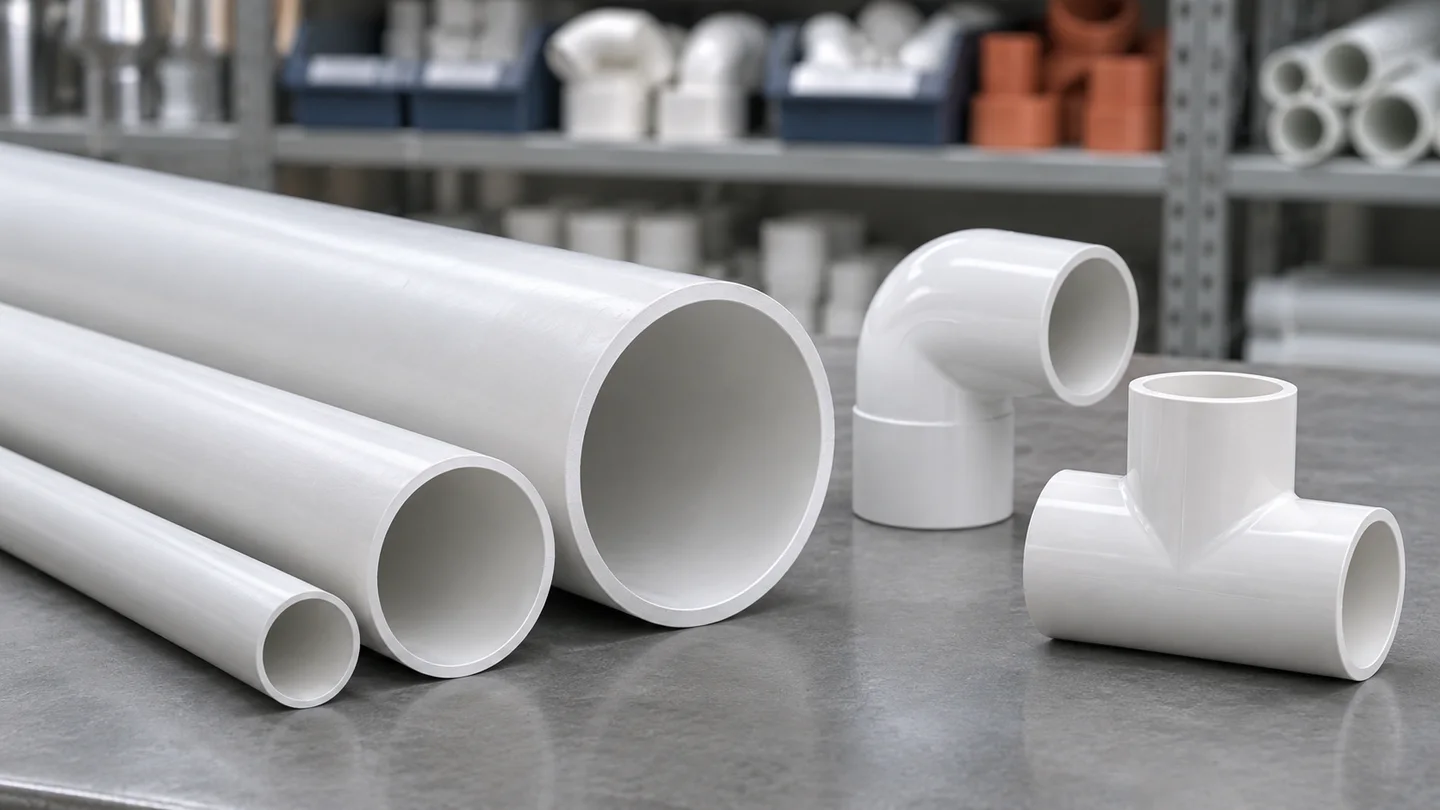
A “1-inch PVC pipe” is identified by its nominal size. That does not mean its outside diameter measures exactly one inch. Before ordering, identify the pipe’s size system and applicable standard, then compare its actual outside diameter, wall thickness, intended service and fitting requirements.
For distributors and project buyers, the important question is not only “What size pipe do I need?” It is also “Will the pipe, fittings, working conditions and documents in this quotation match the system I am buying for?”
This guide covers pipe dimensions, measurements, material suitability and the information needed for a clear quotation.
PVC pipe size chart: nominal size, outside diameter and wall thickness
The following reference examples come from Charlotte Pipe’s PVC 1120 Schedule 40 plain-end product data, identified to ASTM D1785. They are useful for understanding how nominal sizes relate to dimensions. This is a selection of common sizes; consult the linked source for its full product range. These figures are not a specification for HardwareSourceCo products and are not a universal chart for every PVC pipe system.
| Nominal pipe size | Average outside diameter | Minimum wall thickness |
|---|---|---|
| 1/2 in. | 0.840 in. (21.34 mm) | 0.109 in. (2.77 mm) |
| 3/4 in. | 1.050 in. (26.67 mm) | 0.113 in. (2.87 mm) |
| 1 in. | 1.315 in. (33.40 mm) | 0.133 in. (3.38 mm) |
| 1 1/4 in. | 1.660 in. (42.16 mm) | 0.140 in. (3.56 mm) |
| 1 1/2 in. | 1.900 in. (48.26 mm) | 0.145 in. (3.68 mm) |
| 2 in. | 2.375 in. (60.33 mm) | 0.154 in. (3.91 mm) |
| 3 in. | 3.500 in. (88.90 mm) | 0.216 in. (5.49 mm) |
| 4 in. | 4.500 in. (114.30 mm) | 0.237 in. (6.02 mm) |
Source: Charlotte Pipe PVC pressure pipe data. Millimeter figures are calculated as inches × 25.4 and rounded to two decimal places using half-up rounding. The source lists an average outside diameter and a minimum wall thickness; neither value is a complete tolerance range. Obtain the current manufacturer’s dimensional specification before ordering.
How to read the example: the 1-inch nominal line has a listed average OD of 1.315 inches. If your sample measures close to that, it may be a useful starting point for identification—but the measurement alone does not establish the material, standard, pressure rating or fitting compatibility.
What do OD, ID and wall thickness mean?
- Nominal size is the size designation used to identify a pipe within a particular system.
- Outside diameter (OD) is measured across the outside of the pipe, from one outer edge to the other.
- Wall thickness is the thickness of the pipe material between the outer and inner surfaces.
- Inside diameter (ID) is the opening through the pipe. It can vary with the actual wall thickness and tolerances.
Do not calculate a guaranteed ID by subtracting twice the minimum wall from an average OD. That calculation can be useful for illustration, but it does not establish the actual inside diameter of an individual pipe or the limits required by your project.
Where to measure
- Outside diameter (OD): measure from one outside edge to the opposite outside edge.
- Inside diameter (ID): measure across the opening inside the pipe.
- Wall thickness: measure the material between the outside surface and the inside opening at an accessible pipe end.
Record each measurement separately and check the measurement method against the applicable specification.
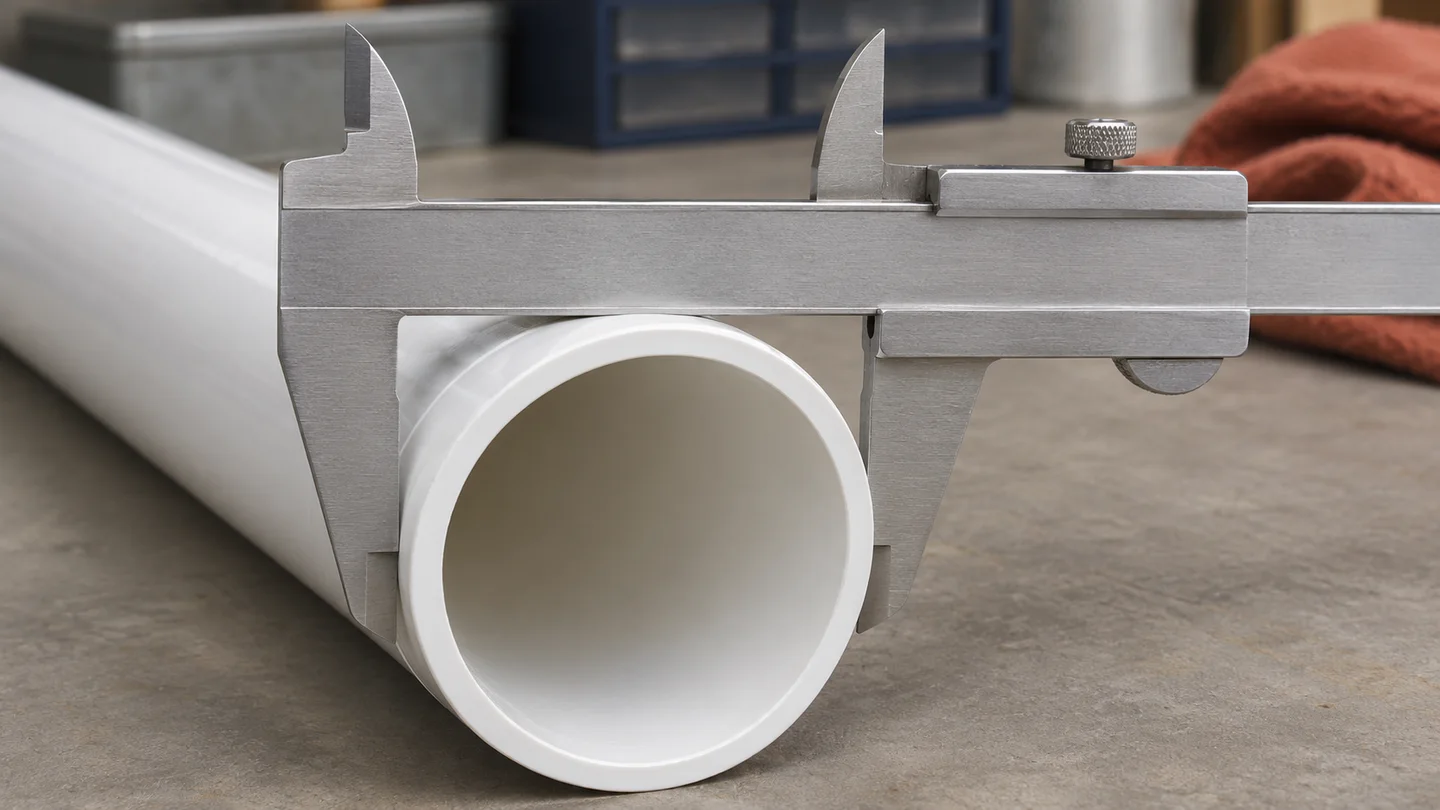
Illustrative AI-generated image; use the written guidance and the supplier’s documentation for measurements.
How to measure PVC pipe before asking for a quote
1. Record the pipe markings
Photograph the full marking along the pipe if it is legible. Record the stated size, material, standard, intended application and any rating or certification marks. If there are no markings, report that the standard and application are unknown; do not guess them from color alone.
2. Measure the outside diameter and wall
Use a suitable caliper where practical. Measure across opposite outside edges, record the unit, and take more than one reading if the end appears damaged or out of round. For wall thickness, measure at an accessible pipe end and record where the reading was taken.
Also measure the supplied or required length per piece. A request for “1,000 pipes” cannot be converted into a total length until the length of each pipe is specified.
3. Check the system, not just the pipe
Send your measurements, photographs and the applicable dimensional standard to the supplier. Ask the supplier to check the pipe and fitting type together. Similar measurements are a reason to investigate, not proof that components are interchangeable.
Schedule 40 vs. Schedule 80: what should a buyer compare?
For the corresponding nominal sizes in the same relevant pipe dimension system, Schedule 40 and Schedule 80 pipes commonly share the same outside diameter while differing in wall thickness. This helps explain why a fitting connection may appear dimensionally similar. It does not mean every Schedule 40 and Schedule 80 product, fitting, joint or system is suitable for the same service.
Check:
- The exact product standard, nominal size and dimensional tolerance.
- Pipe material, wall and fitting or joining method.
- The manufacturer’s pressure rating for the specific product, size and temperature.
- The medium, operating conditions and limitations of every component in the system.
For example, the Charlotte Pipe table lists different working pressures for different nominal sizes at the stated reference temperature. Do not transfer one value to another size, temperature or supplier. Charlotte Pipe technical manual.
The Schedule designation and applicability of the UPVC product shown on this site have not yet been verified against a final model. Ask for the selected product’s documentation before specifying it.
Is PVC pipe suitable for drinking water?
It depends on the exact product, certification and local requirements. “PVC” or “Schedule 40” alone is not proof of drinking-water suitability.
If potable water is involved, tell the supplier the destination and intended use, then request the applicable certification or listing for the exact pipe and any other relevant components. Check the issuing body, standard, covered product, current status and any stated limitations. NSF explains the scope of NSF/ANSI/CAN 61, including pipes and other drinking-water system components. Requirements vary by jurisdiction and application.
A copyable PVC pipe enquiry checklist
Group your requirements under these four headings. If you do not know an item yet, mark it as “to be confirmed.”
1. Project and application
- Project and destination country
- Intended application and fluid
- Operating pressure and temperature
2. Pipe and connection
- Required standard, size system and nominal size
- Measured outside diameter and wall thickness, if replacing a pipe
- Connection type and fittings required
- Drawings, pipe markings or photos available
3. Quantity and delivery
- Length per piece and total quantity
- Packaging requirements and delivery destination
4. Documentation
- Applicable drinking-water certification or other required documents
Example: turning an incomplete request into a useful one
Hypothetical enquiry: “Please quote 1,000 pieces of 1-inch PVC pipe.”
Before comparing prices, ask the buyer or supplier to clarify the applicable standard, length per piece, intended fluid, pressure and temperature, required fitting connection and delivery destination. One supplier may quote a different length or system from another. The numbers of pieces may match while the offers do not.
How to compare two PVC pipe quotations
Compare each offer against the same requirements. Ask about anything a quote does not state.
- Pipe dimensions: standard, size system, nominal size, outside diameter, wall and tolerances.
- Order quantity: length per piece and total number of pieces.
- Service conditions: pressure rating at the specified temperature for the exact pipe.
- Connections: fitting type and whether fittings are included, optional or not stated.
- Documentation: required certification and whether it covers the selected product.
- Commercial terms: packaging, delivery and trade terms.
Frequently asked questions
Is nominal PVC pipe size the same as outside diameter?
Not necessarily. Nominal size is a designation. Use the applicable dimensional table to identify the corresponding OD and tolerance for the relevant pipe system.
Are pipes with the same nominal size always interchangeable?
No. Confirm the applicable size system, dimensions, materials, connections, pressure and application. The same label alone does not establish that the whole assembly is suitable.
Can I use a size-chart pressure value for my order?
Only if the value is confirmed for the exact product and its operating conditions. Ask for the selected manufacturer’s current data and check the complete system.
What should I request for a potable-water project?
Identify the destination and application, and ask for applicable product documentation and current certification or listing that covers the selected model. Verify local project requirements separately.
Discuss your PVC water pipe requirements and include the standard, dimensions, intended application and quantity in your enquiry.